
Every year, AI predictions center on a few themes: bigger models, more data, and faster compute. The implicit assumption has been a relentless, linear arms race driven by the industry's giants: more scale equals more success.
My prediction for 2026 is that this era will peak, and a fundamental shift will occur.

Prediction: The Era of Endless Data Center Expansion Will Peak
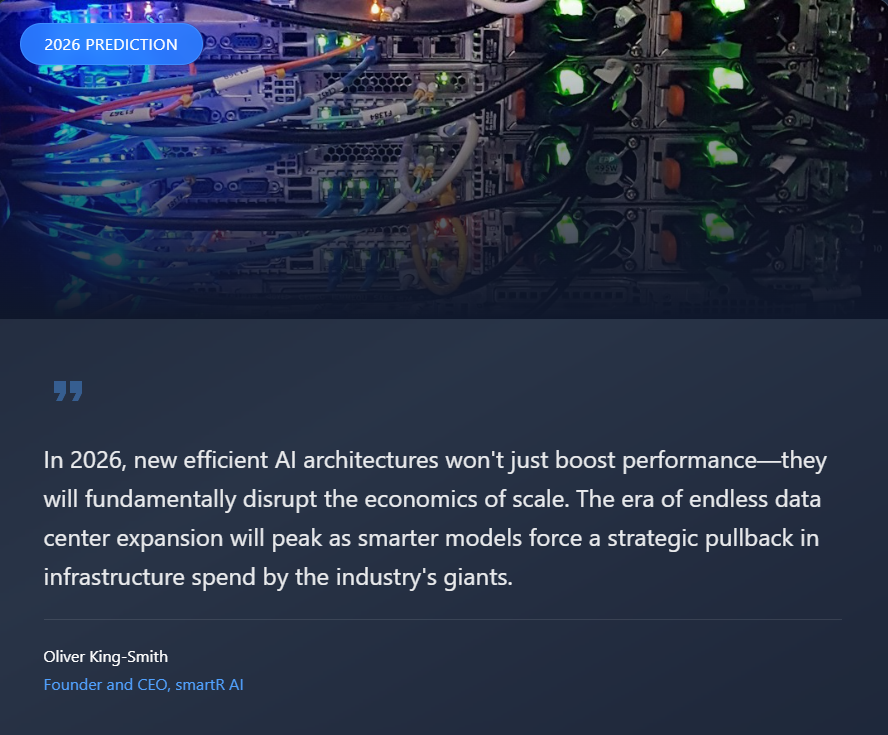
In 2026, the arrival of new, truly efficient AI architectures will do more than just boost model performance—they will fundamentally disrupt the economics of scale. Sourcing massive GPUs and building gargantuan data centers has defined the past few years. But as smarter models emerge, the calculus will change, forcing a strategic pullback and optimization in infrastructure spend by the industry's giants.
Why the Economics Must Change
The current AI model is financially and environmentally unsustainable. The demand for compute capacity, primarily for training, has grown exponentially. Companies are betting the bank on building more and more physical infrastructure to host models that are often bloated and wasteful.
This pressure is driving a revolution at the architectural level:
- The Power of Pruning and Sparsity: New research is demonstrating that you can achieve near-identical performance with a fraction of the total parameters by smartly pruning, quantizing, or using sparse activation techniques. This translates directly into lower inference costs and less heat generation.
- Specialized Architectures: We are moving away from monolithic, multi-trillion parameter models used for every task. The future is a distributed network of highly specialized, smaller models—like the agentic systems we develop with SCOTi—that are fine-tuned for a single, narrow task. These smaller models require significantly less hardware and energy to run at scale.
- The Competitive Efficiency Crunch: The sheer capital expenditure (CapEx) required to maintain the current arms race is staggering. It puts immense pressure on organizations to extract meaningful ROI. The technology that succeeds in 2026 won't be the biggest; it will be the most cost-effective and resource-efficient in solving real-world business problems.
The Strategic Pullback
For years, the industry leaders could afford to absorb inefficiency as they chased capability. Now, the market is demanding pragmatism.
The realization is setting in: if an optimized, smaller model can achieve 95% of the performance of a model ten times its size, but at 1/10th the cost and energy footprint, the incentive to over-scale evaporates. The financial and environmental imperative to be smart, not just big, is becoming undeniable.
This shift means the focus for infrastructure investment will move from quantity (building more massive data halls) to quality (specialized chips, optimized cooling systems, and smarter, AI-driven workload distribution). The strategic value lies no longer in owning the most hardware, but in owning the most efficient algorithms to utilize that hardware.
Your Next Move: Focus on Efficiency
For enterprises, this isn't just an industry prediction—it's a directive.
Don't wait for the largest vendor to figure out how to manage their escalating CapEx. Instead, focus your 2026 AI strategy on partners and architectures that prioritize:
- Assistive Intelligence: Use narrow, focused AI agents that augment human workers, which are inherently more efficient than trying to replace entire human roles.
- Validation, Not Scale: Rigorously define your use case and establish a validation set. An efficient model that solves a defined problem is more valuable than a massive model that vaguely might solve many problems.
- Context Engineering: Invest in structured data and the systems that intelligently feed that data to the model, reducing the model's complexity and inference cost.
The race to build bigger models is the past. The race to build smarter, cheaper, and faster models is the future of AI in 2026.
Written By Oliver King-Smith, Founder and CEO of smartR AI